
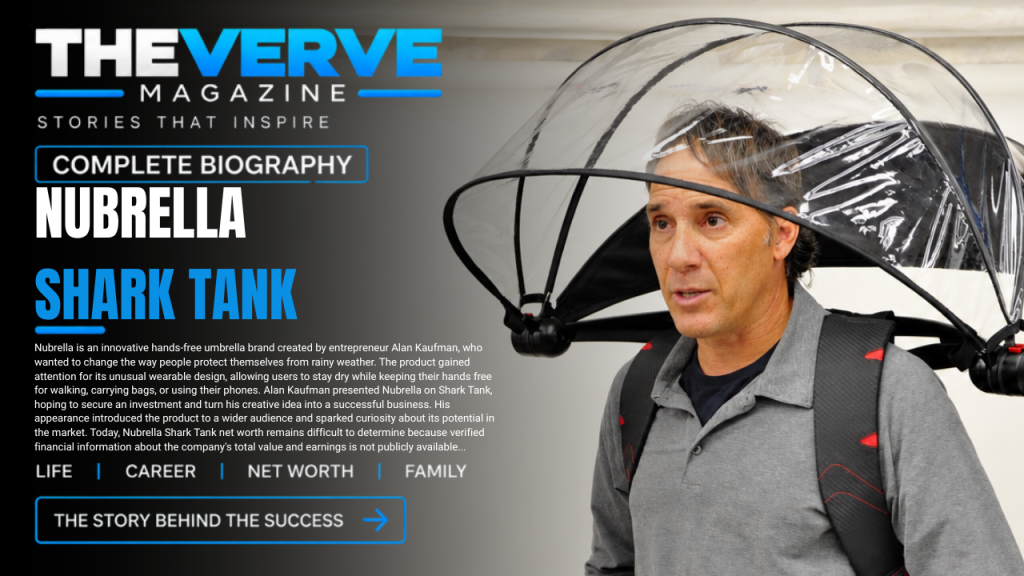
Nubrella was built around a simple frustration: holding an umbrella in the rain leaves one hand occupied, and strong winds can turn an ordinary walk into a struggle. Inventor and entrepreneur Alan Kaufman believed he had a better answer. His solution was a wearable, hands-free umbrella that looked more like a transparent protective dome than a conventional rain shield.
When Kaufman brought Nubrella to Shark Tank in February 2010, he was seeking investment to take the unusual product to a much larger market. He left the televised pitch having accepted an offer from Daymond John and Kevin Harrington. Yet the deal did not ultimately close, and the business’s later history proved more complicated than the television moment suggested.
That is why the search for Nubrella Shark Tank net worth needs a careful answer. Online articles sometimes assign the company a multimillion-dollar value, but there is no independently verified current valuation that establishes what Nubrella is worth today. The business’s historical sales, its proposed investment deal, its redesign and eventual closure provide a more useful picture than an unsupported number.
The story is also about the difference between getting attention and building a sustainable business. Nubrella attracted television exposure and continued development after its appearance, but publicity alone could not guarantee lasting commercial success.
Nubrella at a Glance
| Detail | Information |
|---|---|
| Company name | Nubrella |
| Founder and inventor | Alan Kaufman |
| Product | Wearable, hands-free umbrella |
| Industry | Consumer products and weather protection |
| Shark Tank appearance | Season 1, Episode 14 |
| Episode air date | February 5, 2010 |
| Original investment request | $200,000 for 25% equity |
| Televised offer accepted | $200,000 for 51% equity |
| Final status of the deal | Did not close |
| Later product name | Canope |
| Current business status | Reported closed; original company entity is inactive |
| Current net worth | Not publicly verified |
| Founder’s personal net worth | Not publicly verified |
The distinction between the company’s value and Kaufman’s personal wealth matters throughout this story. A proposed investment does not establish a founder’s net worth, and a company’s past revenue does not reveal how much money its owner ultimately retained.
What Was Nubrella, and Why Was It Different?
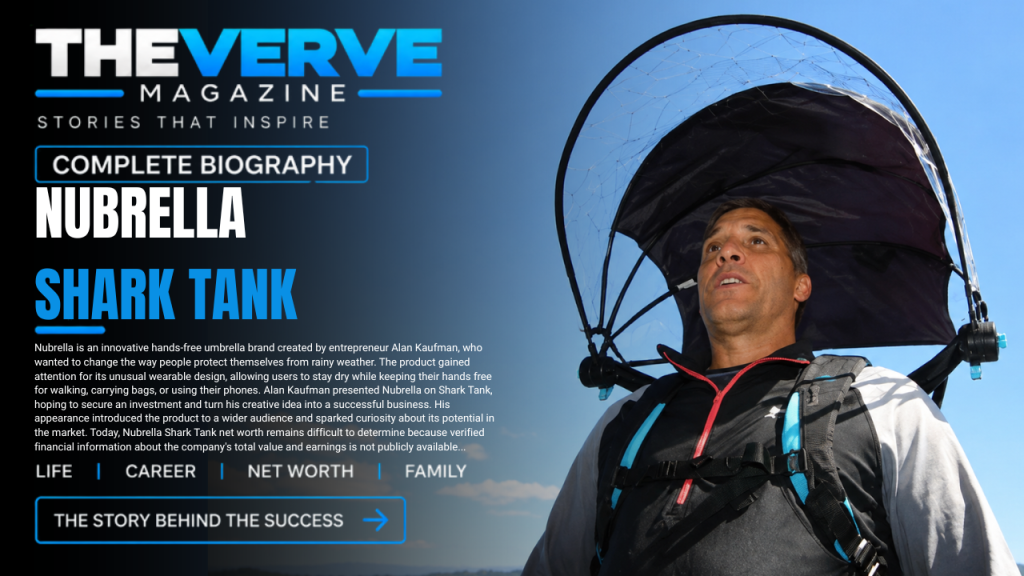
Nubrella was designed to solve a familiar problem in an unfamiliar way. A conventional umbrella depends on the user holding a handle above their head. Nubrella instead used a shoulder-supported frame and a canopy that extended around the head and upper body, leaving both hands available.
The product was intended for people who needed to move around in poor weather while carrying bags, using equipment or working outdoors. Its design also aimed to deal with wind more effectively than a traditional umbrella. When Wired covered the product in February 2008, it described the shoulder-strap construction and reported the company’s claim that the canopy could withstand gusts of up to 50 miles per hour. That was a product claim, not an independent guarantee of performance in every condition.
The concept was easy to understand: keep the user dry without requiring them to hold an umbrella. The harder question was whether people would actually want to wear it.
A wearable canopy is more conspicuous than a standard umbrella. Its bulk, appearance and effect on visibility could matter just as much as its practical benefits. For some potential customers, those trade-offs might be worthwhile. For others, the familiar umbrella remained simpler and more socially comfortable.
That tension became central to Nubrella’s commercial story. It wasn’t enough to demonstrate that the invention was different. Kaufman needed to convince customers that the difference made their lives better.
Who Was Alan Kaufman, the Inventor Behind Nubrella?
Alan Kaufman was the entrepreneur behind Nubrella, and his role extended beyond presenting the product on television. He spent years developing the design, bringing versions to market and attempting to find a sustainable route to wider distribution.
In a 2016 profile, Inc. described Kaufman as an entrepreneur based in Newton, Massachusetts, who had worked on the concept for approximately 14 years. The article documented how he continued refining the product long after its first launch, rather than treating the original design as a finished invention.
That persistence is important to understanding the business. Nubrella wasn’t a product created overnight for a television appearance. It had been available before the show, and Kaufman had already invested substantial time in its development.
The public record is much stronger on his work with Nubrella than on his personal finances. Reliable public sources do not establish a comprehensive picture of his assets, liabilities, property or investments outside the company. Consequently, assigning him a precise personal net worth would go beyond the available evidence.
The Difference Between an Inventor’s Investment and Personal Wealth
Entrepreneurs often put their own money into a product before outside investors become interested. That money can pay for prototypes, manufacturing, patent work, inventory, marketing and product redesigns.
But money invested in a business is not the same as money earned from it. If a founder spends hundreds of thousands of dollars developing an invention, that figure describes the scale of the financial commitment—not the value of the founder’s remaining assets.
Nubrella illustrates why that distinction matters. Even if a founder’s investment helped create a product with real sales, it doesn’t tell us whether the business ultimately repaid the investment, generated a profit or left the founder with a substantial financial return.
Nubrella’s Shark Tank Pitch: The $200,000 Deal
Nubrella appeared on Shark Tank on February 5, 2010, during the show’s first season. Kaufman sought $200,000 in exchange for 25% of the company. At that asking price, his proposal implied a company valuation of $800,000 before the proposed investment.
The Sharks’ decision came down to more than whether the invention was clever. A consumer product must be manufactured at a viable cost, priced attractively, distributed efficiently and purchased repeatedly—or sold in sufficient volume—to support a business. An unusual design may attract attention while still struggling to become a routine purchase.
Kaufman ultimately accepted a joint offer from Daymond John and guest Shark Kevin Harrington: $200,000 for a 51% stake. Based purely on those proposed terms, the offer implied a post-investment valuation of roughly $392,000.
The difference between the original request and the final offer was significant. Kaufman had entered the Tank asking to sell a minority share. The accepted proposal would have given the investors majority ownership.
Yet the agreement viewers saw on television wasn’t the end of the story.
Did the Nubrella Shark Tank Deal Actually Close?
No. Post-show reporting indicates that the proposed investment did not ultimately close. Shark Tank Blog’s retrospective says Harrington concluded that the product’s price point wasn’t suitable for his infomercial business, while attempts by John to help with distribution also failed to produce a completed partnership.
This is a crucial detail for anyone researching Nubrella’s net worth. The company should not be described as having received $200,000 from the Sharks simply because Kaufman accepted the televised offer.
A pitch-show agreement can be subject to further due diligence and negotiations after filming. The final terms may change, or the investment may not happen at all. In Nubrella’s case, the available reporting points to a deal that fell through rather than a completed transaction.
What the Proposed Deal Valuation Really Means
The figures from the episode are useful historical reference points, but they are not present-day valuations.
| Financial detail | What it tells us |
|---|---|
| $200,000 for 25% | Kaufman’s original investment request |
| $800,000 implied valuation | The valuation suggested by his initial proposal |
| $200,000 for 51% | The joint offer accepted on television |
| About $392,000 implied valuation | The approximate post-investment value suggested by the proposed terms |
| Completed investment | Not confirmed; post-show reporting says the deal fell through |
| Current company value | Not publicly verified |
The $800,000 and roughly $392,000 figures arise from different proposed equity arrangements. Neither should be presented as an audited valuation, a sale price or proof of what the business was worth years later.
Most importantly, neither figure tells us Kaufman’s personal net worth. A company valuation is not a bank balance, and an offer that never closes doesn’t put the offered cash into a founder’s account.
What Happened to Nubrella After Shark Tank?
The failed deal did not immediately end Nubrella. Kaufman continued working on the product, seeking customers and adjusting its design. The company’s later history shows a business that remained active for years after its television appearance, even without the promised investment partnership.
Redesigning the Original Product
The early design had an obvious practical challenge: the canopy surrounded the user’s face, which could make it feel enclosed and interfere with visibility or conversation. Inc. reported in March 2016 that customers had raised concerns about the original design and that Kaufman had developed a revised version. The newer product used reflective material and could be lowered behind the wearer when not needed.
The redesign was more than a cosmetic adjustment. It addressed a basic question of usability: could a wearable umbrella protect someone from the elements without making ordinary movement and communication uncomfortable?
According to Kaufman’s figures quoted by Inc., the company had sold more than 17,000 units worldwide across its various versions. More than 700 of the redesigned model had reportedly sold since its launch in November before the March 2016 article. These were figures attributed to Kaufman, not audited financial statements.
The sales history suggests that the product found customers. It does not, by itself, establish profitability. To calculate profit, one would also need to know the cost of manufacturing, shipping, returns, marketing, salaries, legal expenses and other business obligations.
The Company Rebranded as Canope
In 2020, Kaufman rebranded the product as Canope and continued pursuing the market under the new name. The change accompanied further efforts to broaden its use beyond rain protection.
A June 2021 report from PetaPixel described Canope as a wearable shade and rain-protection product aimed at people such as photographers and outdoor workers who need their hands free. The updated design used fabric rather than the original clear plastic canopy, and the company said more than 60% of its customers used the product for sun protection. That percentage was the company’s own reported figure.
The shift made commercial sense as a product strategy. Rain is seasonal in many markets, while protection from the sun can be useful in a wider range of outdoor settings. Photographers, event workers and people doing outdoor jobs may also have a more specific reason to value a hands-free design than the average pedestrian.
Still, expanding the product’s purpose didn’t automatically solve every business problem. The company needed to reach the right customers, communicate the product’s advantages and sell enough units at a sustainable margin.
Nubrella’s Reported Revenue
One frequently repeated financial figure is approximately $1 million in annual revenue by July 2021. Shark Tank Blog reported that Kaufman was still selling the Canope product through his website and Amazon at that time.
This is a useful historical marker, but it should be handled carefully. The figure is not a verified current revenue number, and annual revenue is not the same as profit or net worth.
A business can generate $1 million in sales and still have limited cash left after paying for inventory, manufacturing, fulfilment, marketing, development and other costs. Revenue describes money coming in from sales before expenses; profit measures what remains after relevant costs are accounted for.
That distinction is especially important when websites use an old revenue figure to support a current company valuation. Without information about expenses, debts, assets and the period in question, revenue alone cannot produce a reliable net-worth estimate.
Why Did Nubrella Struggle to Become a Mainstream Product?
Nubrella addressed a genuine inconvenience, but solving a problem doesn’t guarantee that consumers will adopt a new solution. Its commercial challenges can be understood through several factors documented in the product’s history.
1. The Design Had to Overcome Its Unusual Appearance
The original product was visually distinctive. That helped it stand out on television, but it also created a barrier for everyday use. Customers had to be comfortable wearing a large canopy around their upper body in public.
The design concerns reported by Inc.—including visibility and communication—showed that practical performance mattered as much as novelty.
A product can work in principle and still struggle if using it feels awkward. For a consumer item intended for daily use, convenience has to outweigh the inconvenience of adopting something unfamiliar.
2. Distribution Was a Major Challenge
A product’s success depends on more than the quality of its design. It must reach customers through channels that make commercial sense.
The Shark Tank partnership was expected to help Nubrella expand, but the proposed deal did not close. Later coverage describes unsuccessful efforts to establish the distribution support discussed after the show.
Without that partnership, Kaufman had to continue pursuing sales and distribution independently. A small business may be able to sell directly online, but reaching a much larger market often requires additional capital, reliable production and strong retail relationships.
3. The Product Needed a Clearly Defined Audience
A traditional umbrella is inexpensive, familiar and easy to carry. Nubrella offered different advantages, but those advantages were most compelling to particular users.
Outdoor workers, photographers and people who regularly need both hands free may have a stronger reason to consider a wearable canopy. For someone walking a short distance between a car and a building, a conventional umbrella might be more appealing.
The later Canope positioning—covering sun protection as well as rain—suggested an effort to reach customers with more specific outdoor needs.
These factors help explain the difficulty of scaling the business, but they shouldn’t be mistaken for a complete financial diagnosis. Without full company accounts, it’s impossible to quantify how much each factor affected Nubrella’s performance.
Legal Disputes Following the Shark Tank Appearance
Nubrella’s story also involved disputes connected to the show’s portrayal of the business and the investment that had been discussed on camera.
In 2016, Kaufman sued Sony Pictures and other parties associated with Shark Tank. Shark Tank Blog reports that he sought compensation for lost investment opportunities and other issues relating to how episodes featuring the product were presented. That account says an earlier state-court dispute resulted in a $20,000 settlement. A separate federal case was later dismissed after the court found that the participant agreement required arbitration.
These details require care. A settlement is not necessarily an admission of wrongdoing, and dismissal on procedural grounds is not the same as a court ruling that every allegation was false. The available reporting describes different legal proceedings with different outcomes.
The dispute matters to Nubrella’s financial history because legal costs and disagreements over commercial opportunities can affect a small business. But there is no reliable public accounting that establishes the total financial impact of the litigation on the company or Kaufman personally.
Nor should the $20,000 settlement be treated as evidence of a major increase in net worth. It was a reported settlement tied to a legal dispute, not a disclosed business sale or valuation.
Is Nubrella Still in Business in 2026?
The available evidence points to Nubrella no longer operating as an active business. Shark Tank Blog reports that the company was shuttered after Kaufman’s death in November 2022.
The original company entity, Nubrella Enterprises LLC, is also described in recent secondary reporting as inactive, with an administrative dissolution recorded in Florida in September 2023. That corporate status is evidence about the entity’s legal standing; it does not, by itself, establish the value of any remaining intellectual property, inventory or other assets.
A necessary distinction remains: a company can stop trading without every asset instantly becoming worthless. Patents, designs, trademarks, inventory or other rights can sometimes retain value after a business closes. But determining whether any of Nubrella’s assets were sold, transferred, licensed or retained—and for how much—would require records that aren’t established by the sources reviewed here.
For that reason, it is more accurate to say that Nubrella’s current net worth is not publicly verified than to assign it a definite value in 2026.
Nubrella Net Worth vs. Alan Kaufman’s Net Worth
The keyword combines two ideas that are often confused: the value of Nubrella as a business and the personal wealth of its founder.
Nubrella’s company value would depend on its assets, liabilities, intellectual property, revenue prospects and any sale or licensing arrangements. If the company is no longer operating, a current valuation would also need to account for what assets remain and whether they have a market.
Alan Kaufman’s personal net worth would include his personal assets and liabilities, plus whatever value he retained in Nubrella and any other financial interests. The company’s sales do not reveal those personal figures.
No reliable public disclosure establishes Kaufman’s total personal net worth. Likewise, the available sources do not provide audited accounts that establish a definitive present-day valuation for Nubrella.
Why Online Estimates Disagree
Online net-worth articles may publish figures such as $1 million, $1.5 million or $2 million. Those figures appear in secondary articles, but they aren’t supported by a disclosed current valuation or a complete set of financial statements.
Several issues can explain the variation:
- Different dates: One estimate may refer to the company’s strongest trading period, while another implies a current value.
- Revenue mistaken for value: A report of annual sales may be used as if it were the business’s total worth.
- Proposed deal terms: The valuation implied by a Shark Tank offer may be repeated without clarifying that the deal never closed.
- Unknown liabilities and costs: Sales figures don’t show debts, legal expenses, inventory costs or operating losses.
- Founder wealth confused with company value: A business’s estimated value is not equivalent to the founder’s personal assets.
A number repeated across several websites doesn’t automatically become reliable if those sites rely on the same unsupported estimate. In Nubrella’s case, the documented history is more informative than any single online figure.
Nubrella’s Career and Business Timeline
| Year | Milestone |
|---|---|
| 2008 | Wired covered Nubrella as a wearable, hands-free umbrella. |
| 2010 | Alan Kaufman pitched Nubrella on Shark Tank and accepted a televised offer. |
| 2010 onward | The proposed Shark Tank investment failed to close, and Kaufman continued independently. |
| 2016 | Inc. reported on a redesigned Nubrella and Kaufman’s claims about worldwide sales. |
| 2016 | Kaufman’s legal disputes involving the show and its portrayal of the business received coverage. |
| 2020 | The product was rebranded as Canope. |
| 2021 | Canope was reported to be generating approximately $1 million in annual revenue. |
| November 2022 | Shark Tank Blog reported Kaufman’s death and the business’s closure. |
| 2026 | No reliable, independently verified current valuation has been established. |
The timeline shows that Nubrella’s story extended well beyond the televised pitch. The product went through redesigns, a new brand identity and years of continued selling. The failed investment was a major setback, but it was not the immediate end of the company.
Confirmed Facts vs. Unverified Claims
| Claim | What the evidence supports |
|---|---|
| Nubrella was founded by Alan Kaufman | Supported by product and business reporting. |
| Kaufman asked for $200,000 for 25% | Reported in Shark Tank coverage. |
| He accepted a $200,000 offer for 51% | Reported as the televised agreement. |
| The investment was completed | Contradicted by post-show reporting, which says the deal fell through. |
| Nubrella later became Canope | Supported by later product coverage. |
| Annual revenue reached about $1 million by 2021 | Reported by Shark Tank Blog; not an audited figure. |
| Nubrella is worth exactly $1.5 million in 2026 | Not independently verified. |
| Alan Kaufman’s personal net worth is known | No reliable public figure established. |
This separation is important because the strongest evidence concerns the product’s history, pitch and reported sales. Claims about exact present-day wealth are much less certain.
Why People Still Search for Nubrella Shark Tank Net Worth
Nubrella remains an interesting search because its story combines an unusual invention, a memorable television pitch and a business outcome that is easy to misunderstand.
The first source of curiosity is the deal itself. Viewers saw Kaufman accept an offer worth $200,000 in exchange for majority ownership. People naturally want to know whether that agreement made him wealthy. The crucial detail—that the deal never closed—changes the financial interpretation completely.
The second is the product’s unconventional design. A wearable umbrella is easy to remember, even for people who never intended to buy one. The original concept and later Canope redesigns also offer a clear example of how inventors sometimes need years of changes to make a product more practical.
Finally, conflicting online estimates create uncertainty. A reader may encounter a multimillion-dollar net-worth claim on one site and a report of the company’s closure on another. Understanding the timeline helps explain why those claims shouldn’t be treated as equivalent evidence.
Nubrella’s legacy is therefore less about a confirmed fortune than about the difficult transition from invention to sustainable business. Kaufman kept developing the product long after the initial television attention, but the available records don’t reveal a definitive final financial outcome.
Frequently Asked Questions
1. What is Nubrella Shark Tank net worth in 2026?
Nubrella’s current net worth has not been independently verified. Some secondary websites publish estimates in the $1 million to $2 million range, but those figures aren’t supported by a disclosed current valuation or audited financial statements. The business was reportedly closed after its founder’s death.
2. Who invented Nubrella?
Nubrella was developed by entrepreneur Alan Kaufman. He created a wearable umbrella designed to provide weather protection without requiring the user to hold a conventional handle. He continued refining the product after its original launch.
3. Did Nubrella get a deal on Shark Tank?
Kaufman accepted a televised offer from Daymond John and Kevin Harrington for $200,000 in exchange for 51% equity. However, post-show reporting says the deal did not close, so the company should not be described as having received that investment.
4. What valuation did Nubrella ask for on Shark Tank?
Kaufman initially asked for $200,000 for 25% of the company, implying an $800,000 valuation before the proposed investment. That was the valuation implied by his request, not an independently verified assessment of the business’s value.
5. How much revenue did Nubrella make?
Shark Tank Blog reported that the business was generating approximately $1 million in annual revenue by July 2021, when it was selling under the Canope name. This is a historical reported figure, not verified current revenue or profit.
6. What happened to Nubrella after Shark Tank?
The proposed investment fell through, but Kaufman continued selling and redesigning the product independently. He later rebranded it as Canope, expanding its intended use to include sun protection as well as rain protection. The business was subsequently reported to have closed.
7. Why did Nubrella change its name to Canope?
The rebranding took place in 2020, as the company continued refining the product and broadening its focus beyond rain protection. A 2021 report described Canope as a hands-free product for sun and rain protection, including for photographers and outdoor workers.
8. Is Nubrella still available to buy?
There is no reliable evidence establishing that the original business continues to operate or that the product is currently available through an active official sales channel. Older articles and listings may remain online after a company closes, so their presence shouldn’t be taken as proof of current availability.
9. What was Alan Kaufman’s net worth?
A reliable figure for Kaufman’s personal net worth has not been publicly established. Reported product sales and his company’s proposed Shark Tank valuation don’t provide enough information to calculate his personal assets, debts or financial returns.
10. Did Alan Kaufman become wealthy from Nubrella?
The public record doesn’t establish whether Kaufman accumulated substantial personal wealth from the invention. His business reportedly achieved meaningful sales and continued operating for years, but the available information doesn’t disclose its full profitability or how much of its earnings he retained.
Final Thoughts
Nubrella’s story is a reminder that an invention can be memorable without becoming a permanent commercial success. Alan Kaufman developed a distinctive solution to an everyday problem, brought it to national television and continued refining it for years after the proposed Shark Tank investment fell apart.
The financial answer, though, remains uncertain. The original pitch implied an $800,000 valuation, the televised offer implied a different figure, and later reporting described annual revenue of approximately $1 million. Each number refers to a different financial measure or point in the company’s history. None establishes Nubrella’s current net worth or Kaufman’s personal fortune.
The most responsible conclusion is that Nubrella has no publicly verified current net-worth figure. Online estimates should be treated cautiously, particularly when they don’t account for the failed investment deal and the company’s later closure.
For readers interested in the wider story, Nubrella is worth remembering not simply for its unusual appearance on Shark Tank, but for the years of product development that followed. It shows how much work can sit behind a short television pitch—and why a compelling invention, publicity and sales don’t always translate into lasting financial success.
[…] of these details are not publicly documented for Duckett. Without them, even an apparently modest estimate can be […]