
Tom Platz is one of those rare bodybuilders whose reputation never depended entirely on winning the sport’s biggest title. He never won Mr. Olympia, yet decades after his competitive career ended, his name remains closely associated with some of the most famous legs and most intense training sessions in bodybuilding history.
That distinction matters when looking at Tom Platz’s net worth. There is no reliable public financial disclosure that establishes an exact figure, and the numbers published online vary dramatically. Some websites put his wealth around $1 million, while others claim several million dollars or far more. The evidence simply isn’t strong enough to treat any of those figures as an official valuation.
What can be established is how Platz built a career that extended well beyond contest winnings: bodybuilding, books, seminars, education, speaking, media appearances, fitness-related work and a long-running reputation that continues to generate professional opportunities.
As of October 2026, Platz is 71 years old. He was born on June 26, 1955, at Fort Sill, Oklahoma.
| Detail | Information |
|---|---|
| Full Name | Thomas Steven Platz |
| Known As | Tom Platz |
| Nicknames | The Golden Eagle, The Quadfather |
| Date of Birth | June 26, 1955 |
| Age | 71 as of October 2026 |
| Birthplace | Fort Sill, Oklahoma, U.S. |
| Nationality | American |
| Profession | Retired professional bodybuilder, fitness educator, speaker |
| Competitive Era | Primarily 1970s–1980s |
| Best Mr. Olympia Finish | 3rd place, 1981 |
| Major Amateur Achievement | 1978 World Amateur Championships |
| Book | Pro-style Bodybuilding |
| IFBB Hall of Fame | Inducted in 2003 |
| Exact Net Worth | Not publicly verified |
Tom Platz Net Worth: What Is the Most Credible Estimate?
The honest answer is that Tom Platz’s exact net worth is not publicly known.
That may sound less satisfying than a headline claiming “$5 million” or “$10 million,” but it is the more responsible conclusion. Platz is a retired athlete and private individual rather than the owner of a publicly traded company whose assets and earnings can be examined through financial filings.
Online estimates are inconsistent. One recent source places his wealth around $1 million, while another estimates a range of roughly $3 million to $5 million. A separate website has published dramatically higher figures, including a $125 million estimate, but it openly says its numbers are algorithmically calculated from social factors rather than verified financial records.
That last distinction is crucial.
A social-media-based earnings calculation is not the same thing as a net-worth statement. Even an estimate of possible annual sponsorship income cannot tell us how much someone owns, owes, has invested, has spent or has accumulated over several decades.
For that reason, a defensible article should not present one precise dollar figure as fact.
A reasonable reading of the available public estimates is that Platz has accumulated substantial wealth through a long career in fitness and bodybuilding, but the exact amount remains undocumented. Estimates in the low-single-digit millions appear considerably more plausible than extreme claims, yet even those should be treated as estimates rather than established financial facts.
How Tom Platz Built His Wealth
Platz’s financial story is more interesting than a simple contest-prize calculation.
His professional bodybuilding career lasted only part of his working life. After leaving competition, he continued to monetize the expertise and recognition he had built through bodybuilding.
His income opportunities have included:
- Fitness education
- Bodybuilding seminars
- Public speaking
- Training and consulting
- Books and educational material
- Video and media projects
- Guest appearances
- Fitness-related business activities
- Industry partnerships and endorsements
- Modern digital and social-media visibility
Some of these activities are documented, while the financial value attached to them is not.
That distinction should always be maintained when discussing celebrity wealth.

Competition Money Was Only One Piece of the Puzzle
Platz competed during a period when professional bodybuilding was nowhere near as financially lucrative as it is in some parts of today’s fitness industry.
His best Mr. Olympia result came in 1981, when he finished third behind Franco Columbu and Chris Dickerson. The published results show Platz receiving $6,000 for third place that year, while Columbu received $25,000 for first.
That tells us something important about his eventual wealth.
Platz could not have built a modern multi-million-dollar fortune simply by collecting bodybuilding prize money. His long-term financial story had to involve what happened after and around competition, including his ability to turn his reputation into a broader professional career.
Who Is Tom Platz?
Thomas Steven Platz was born in Oklahoma in 1955 and became fascinated with bodybuilding at a remarkably young age.
His early inspiration was Dave Draper, a major bodybuilding figure of the era. Platz later recalled being strongly affected by seeing Draper and eventually developing a serious commitment to bodybuilding.
His childhood interest became something much more serious during his teenage years.
By the 1970s, Platz was competing in amateur bodybuilding and powerlifting. His contest record includes victories at events such as Mr. Michigan and Mr. Southeastern USA, followed by increasingly significant national and international competitions.
The young bodybuilder was not simply chasing appearance. He became fascinated with training intensity, strength and the psychology behind pushing physical limits.
That mentality would eventually become a major part of his public identity.
Early Career and the Road to California
Platz’s competitive career began in the early 1970s.
He competed at events including Mr. Adonis and Mr. Ironman in 1973, then continued building his record through the middle of the decade. In 1975, he won Mr. Michigan, and in 1977 he won Mr. Southeastern USA.
His breakthrough as an international bodybuilding prospect came in 1978.
That year, he won the middleweight division at the IFBB World Amateur Championships. Contest records also list him as the winner of the USA World Qualifier that year.
After completing his education, Platz moved to California, the heart of the American bodybuilding scene.
That move was important professionally. California in the late 1970s wasn’t simply another place to train; it was one of the central stages of the bodybuilding culture that would later become globally influential.
Platz arrived with ambitions of reaching the highest level.
He eventually did.
The Bodybuilder Who Became Famous for His Legs
Platz’s physique was unusual even by professional bodybuilding standards.
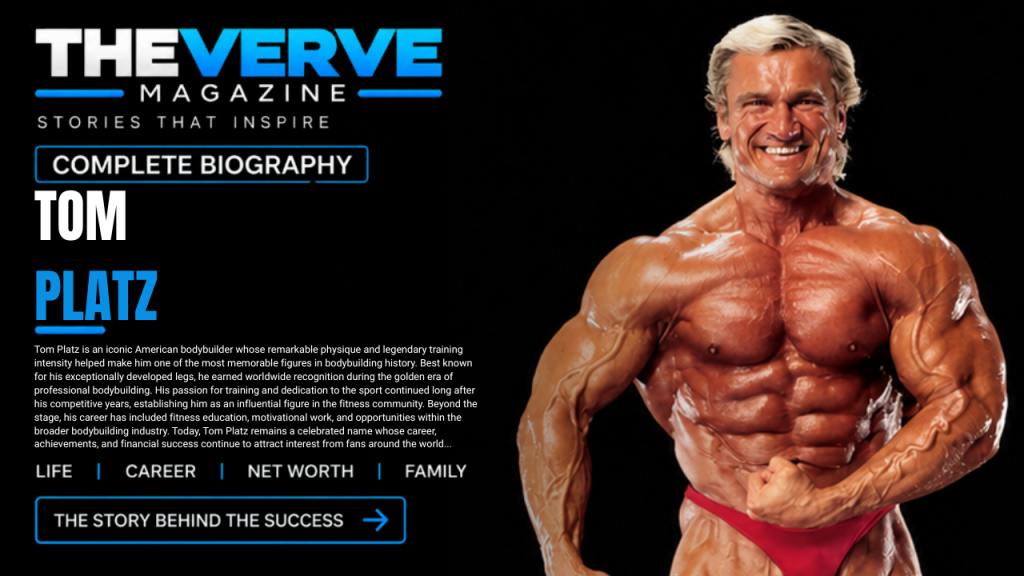
His quadriceps became his defining feature. During his competitive prime, his legs were exceptionally developed, giving him the nickname “The Quadfather.” His training sessions became almost as famous as his contest appearances.
The mythology surrounding Platz’s leg training has endured because there was genuine substance behind it.
He became known for extraordinarily demanding squat sessions and a willingness to continue working long after conventional notions of discomfort would have suggested stopping. His training philosophy emphasized intensity, concentration and psychological commitment.
Modern coverage continues to revisit those workouts, including accounts of Platz performing extremely high-repetition squats with heavy weights.
But the most interesting part of Platz’s legacy isn’t simply how much weight he moved.
It is the association between his physique and his mentality.
For generations of lifters, “Tom Platz legs” became shorthand for extreme dedication to lower-body training.
Tom Platz and Mr. Olympia
Platz made his Mr. Olympia debut in 1979 and finished eighth in the under-200-pound class. He returned in 1980 and finished ninth overall.
Then came 1981.
It remains the defining competition of his career.
The 1981 Mr. Olympia was held on October 10 in Columbus, Ohio. Franco Columbu won, Chris Dickerson finished second and Tom Platz placed third.
The result remains one of the most debated contests in bodybuilding history.
Contemporary and retrospective accounts describe a highly controversial judging outcome, with parts of the audience openly unhappy with the final placings. Muscle & Fitness has described the 1981 result as arguably one of the most disputed Olympia outcomes in the sport’s history.
Platz himself became part of the mythology of that contest.
He never won the Sandow, but his third-place finish in 1981 became more memorable to many fans than some champions’ victories.
That is an unusual form of sporting fame.
His Mr. Olympia Record After 1981
Platz remained a regular presence at the Olympia for several more years.
His documented placings include:
| Year | Mr. Olympia Result |
|---|---|
| 1979 | 8th |
| 1980 | 9th |
| 1981 | 3rd |
| 1982 | 6th |
| 1984 | 9th |
| 1985 | 7th |
| 1986 | 11th |
He also competed at other professional events, including the 1980 World Pro Championships, where he finished second, and the 1987 Detroit Pro Invitational, where he placed sixth.
Platz eventually stepped away from professional competition.
And that’s where his financial story becomes more interesting.

Tom Platz’s Career After Competitive Bodybuilding
Many professional athletes struggle to build a second career after retirement.
Platz found a way to make his expertise itself into a career.
He became involved in education, seminars, speaking and fitness-related projects. Sources covering his professional background describe advanced study in fitness and related disciplines, as well as teaching and leadership work in bodybuilding education.
He also became a recognizable speaker.
That skill mattered.
Platz was never simply known for having large legs. He was known for being highly expressive when discussing training, competition and motivation. His seminars often became performances in their own right.
That ability gave him something many retired athletes don’t have: a professional identity that could survive after physical competition ended.
Education and Teaching
Platz’s academic background also helped separate him from the stereotypical image of a professional bodybuilder.
Available biographical records associate him with studies in physiology, nutrition, fitness science and business administration, including education connected with Wayne State University, Michigan State University and the University of California.
He also spent years involved in bodybuilding education.
This matters when considering his income.
Teaching and consulting may not attract the same attention as a Mr. Olympia trophy, but they can create a much more durable professional model. An athlete’s competitive career might last ten years; expertise can be sold for decades.
Platz understood that transition.
Tom Platz as an Author
Platz also expanded his reach through publishing.
In 1985, he co-authored Pro-style Bodybuilding with Bill Reynolds. The book was published by Sterling and ran 192 pages. WorldCat and Google Books both document the publication.
The book is significant because it shows that Platz’s public identity had already moved beyond competition.
He wasn’t simply appearing on stage. He was documenting and communicating his approach to bodybuilding.
For a professional athlete, publishing creates another form of intellectual property. A book can remain available long after an athlete stops competing.
Tom Platz and Vince McMahon’s World Bodybuilding Federation
One of the more unusual chapters in Platz’s career came in the early 1990s.
In 1990, Vince McMahon’s company began developing a competing bodybuilding organization that eventually became the World Bodybuilding Federation.
Platz was involved with Bodybuilding Lifestyles and was announced as the organization’s Director of Talent Development. He famously appeared at the 1990 Mr. Olympia in Chicago and helped announce the new organization.
The WBF did not last.
It was dissolved in 1992 after a short-lived attempt to challenge the established bodybuilding structure.
Financially, the episode is interesting because it demonstrates the range of opportunities that opened around Platz’s reputation.
He wasn’t just a former competitor.
He had become an industry personality.
Did Tom Platz Make Most of His Money From Bodybuilding?
Probably not from competition alone.
That’s an important distinction.
Professional bodybuilding prize money during Platz’s era was modest compared with the lifetime financial opportunities available to established fitness personalities today. His documented third-place Olympia prize in 1981 was $6,000.
His later earning potential came from the much broader ecosystem surrounding bodybuilding.
Seminars, education, speaking engagements, books, media appearances and fitness consulting can all generate revenue without requiring an athlete to compete.
Platz also developed a recognizable personal brand before the phrase “personal brand” became standard business language.
His legs were the visual hook.
His knowledge and personality kept people interested.
Why Tom Platz’s Net Worth Estimates Vary So Much
There are several reasons online estimates don’t agree.
No Public Financial Disclosure
There is no publicly available audited statement showing Platz’s total assets, investments, property, business equity and liabilities.
Without that information, an exact net-worth figure is impossible to verify.
Different Definitions of “Net Worth”
Some websites appear to estimate annual income and then treat it as evidence of wealth.
That’s not how net worth works.
Someone earning $200,000 a year isn’t necessarily worth $200,000, $1 million or $10 million. Wealth depends on accumulated assets and liabilities.
Social-Media Calculations Are Not Wealth Statements
One current website estimates substantial potential annual social-media income for Platz based on audience and engagement metrics, while explicitly acknowledging that the figures are algorithmic estimates and aren’t verified by the account owner.
That can provide context about digital commercial potential, but it cannot establish his personal net worth.
Internet Estimates Get Repeated
Once a number appears on one celebrity-finance website, other websites can repeat it.
After enough repetition, an estimate can start looking like a fact.
That doesn’t make it one.
For Tom Platz, the safest conclusion is that he is financially successful by the standards of a long-running fitness personality, but his exact wealth is not publicly established.
Tom Platz Net Worth in 2026: What Can Actually Be Said?
As of 2026, publicly available estimates range widely enough that choosing a single figure would create false precision.
Some sources suggest around $1 million. Others place him in the $3 million–$5 million range. Still others publish dramatically larger figures without providing evidence capable of supporting those numbers.
For an evidence-based profile, the most responsible wording is:
Tom Platz’s net worth is not publicly verified. Available online estimates generally place him somewhere in the low-single-digit millions, but there is insufficient reliable financial information to confirm an exact amount.
That answer may be less dramatic than a headline number, but it is much more defensible.
Tom Platz’s Personal Life
Platz has generally kept his private life less prominent than his professional identity.
Public biographical sources identify his wife as Cha Nikito-Platz and have described the couple’s involvement in fitness-related projects.
There is no strong reason to turn his personal life into speculation.
His public legacy has overwhelmingly been built around bodybuilding, education, training philosophy and professional work.
That is where the evidence is strongest.
Tom Platz’s Acting and Media Appearances
Platz also made appearances outside traditional bodybuilding.
His listed screen credits include appearances in The Comeback, Twins, Book of Love, Flex…Body Love, 8 Heads in a Duffel Bag and Who Killed Johnny Love?
These weren’t the core of his career, but they demonstrate how recognizable his bodybuilding persona became.
For entertainment audiences, the oversized physique and unmistakable personality made him an easy fit for fitness-related roles and appearances.
Why People Still Search for Tom Platz
The continued interest in Platz isn’t simply nostalgia.
His name keeps resurfacing because his training methods remain part of bodybuilding culture.
Recent coverage in 2026 has continued to discuss his approach to leg training and the mentality behind his workouts. One August 2026 article, for example, highlighted comments from Platz about the mental side of training and his intense approach to self-competition.
A September 2026 podcast episode likewise revisited his career, legendary leg development and famous high-repetition squat stories.
That gives the “Tom Platz” search a different quality from many celebrity searches.
People aren’t only looking for his age or net worth.
They’re looking for the story behind the physique.
Confirmed Facts vs. Online Claims
Confirmed
- Tom Platz was born June 26, 1955.
- He was born at Fort Sill, Oklahoma.
- He became a professional bodybuilder.
- He won the 1978 IFBB World Amateur Championships middleweight title.
- He placed third at the 1981 Mr. Olympia.
- He competed professionally through the 1980s.
- He authored Pro-style Bodybuilding with Bill Reynolds.
- He was inducted into the IFBB Hall of Fame in 2003.
Reported
- His post-competition career included extensive seminar work, education and fitness-related consulting.
- He has continued appearing in bodybuilding discussions and educational settings.
Unverified
- Any exact current net-worth number.
- Claims that he is worth tens or hundreds of millions of dollars.
- Exact annual earnings from social media, sponsorships or private business interests.
The difference between these categories is important. A strong biography shouldn’t blur them together.
Interesting Facts About Tom Platz
- He began developing an interest in bodybuilding while still very young.
- Dave Draper was one of his early inspirations.
- His legs became his defining physical characteristic.
- His best Mr. Olympia finish was third, not first.
- The 1981 Olympia remains one of the most controversial contests in bodybuilding history.
- He won an IFBB world amateur title in 1978.
- He co-authored a bodybuilding book published in 1985.
- He became involved in Vince McMahon’s WBF project in the early 1990s.
- He was inducted into the IFBB Hall of Fame in 2003.
- His training philosophy continues to be discussed by modern lifters and bodybuilding media.
What Is Tom Platz Doing Now?
Platz’s competitive bodybuilding days are long behind him, but his connection to the sport hasn’t disappeared.
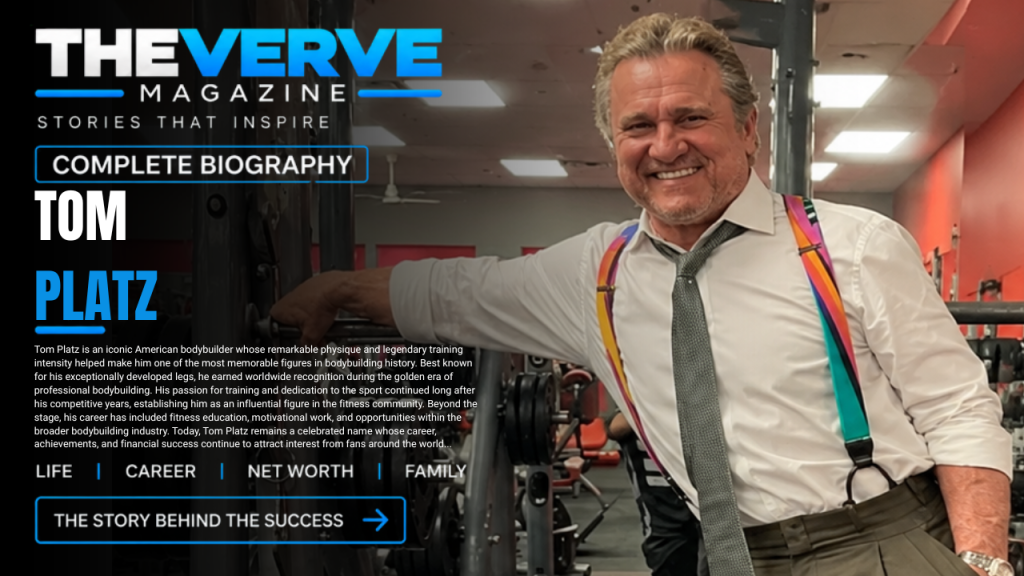
He continues to appear in interviews, seminars and bodybuilding-related media, while modern fitness audiences continue discovering old footage of his training and posing.
That is perhaps the most remarkable part of his longevity.
A bodybuilder’s competitive physique eventually changes. Records get broken. New champions arrive.
But a distinctive personality can last.
Platz’s identity was never built solely around a trophy. His speaking ability, teaching background, extreme training philosophy and unmistakable physique gave him several ways to remain relevant.
Recent 2026 coverage shows that interest in his training mindset is still active, particularly among audiences fascinated by old-school bodybuilding and extreme leg development.
Tom Platz’s Lasting Influence on Bodybuilding
There are champions.
Then there are figures who become symbols of an era.
Tom Platz belongs to the second category.
His competition record is respectable, but it doesn’t fully explain his fame. Plenty of bodybuilders have finished higher at Mr. Olympia and received larger prizes.
Few became as closely identified with one aspect of bodybuilding as Platz became with legs.
The “Quadfather” image has survived because it communicates something instantly recognizable. You don’t have to know the details of 1981 judging or the IFBB’s history to understand why Tom Platz is famous.
And his influence goes beyond anatomy.
His seminars and interviews repeatedly returned to effort, preparation, mental toughness and the willingness to push beyond comfort. Modern fitness culture is much larger than the bodybuilding industry of Platz’s competitive years, yet his name still appears whenever extreme leg training is discussed.
That’s a form of cultural value that doesn’t show up on a balance sheet.

Frequently Asked Questions
How old is Tom Platz in 2026?
Tom Platz is 71 years old as of October 2026. He was born on June 26, 1955, in Fort Sill, Oklahoma.
What is Tom Platz’s net worth?
Tom Platz’s exact net worth has not been publicly verified. Online estimates vary from roughly $1 million to several million dollars, but there is no audited financial record establishing a precise figure.
Did Tom Platz ever win Mr. Olympia?
No. Platz never won the Mr. Olympia title. His best result was third place in 1981, behind Franco Columbu and Chris Dickerson.
Why is Tom Platz famous?
Platz is best known for his extraordinary leg development and famously intense training style. His quadriceps became so closely associated with his identity that he earned the nickname “The Quadfather.”
What was Tom Platz’s best Mr. Olympia finish?
His best Mr. Olympia result was third place in 1981. He also finished sixth in 1982, seventh in 1985 and competed in several other Olympia contests during the 1979–1986 period.
When did Tom Platz start bodybuilding?
Platz developed an interest in bodybuilding at a young age. Biographical accounts trace his serious interest to his childhood and teenage years, with Dave Draper serving as an important early inspiration.
What is Tom Platz known for besides bodybuilding competitions?
He became known for fitness education, seminars, motivational speaking, training philosophy, books and media appearances. He also became involved in the short-lived World Bodybuilding Federation project associated with Vince McMahon.
Did Tom Platz write a book?
Yes. He co-authored Pro-style Bodybuilding with Bill Reynolds, published by Sterling in 1985.
Is Tom Platz in the IFBB Hall of Fame?
Yes. Tom Platz was inducted into the IFBB Hall of Fame in 2003.
Is Tom Platz still involved in bodybuilding?
Although he no longer competes professionally, Platz has remained connected with bodybuilding through speaking, seminars, interviews, educational material and appearances. Recent coverage in 2026 shows that his training philosophy continues to attract attention.
Final Thoughts
Tom Platz’s financial story is ultimately less straightforward than the numbers found on celebrity net-worth websites.
There is no reliable public document that tells us exactly how much money he has accumulated. Claims ranging from around $1 million to several million dollars—and even vastly higher figures—circulate online, but the evidence behind them varies dramatically.
What can be established is more compelling.
Platz built a career that outlived his competitive years. He turned an extraordinary physique into a recognizable identity, then turned that identity into education, speaking, publishing, seminars and media opportunities. His third-place Mr. Olympia finish in 1981 may not look like the résumé of a champion, but his enduring reputation shows that sporting influence isn’t always measured by trophies.
More than four decades after his most famous competitive years, people are still studying his legs, replaying his workouts and discussing his approach to training.
For Tom Platz, that may be the most valuable legacy of all.